06. Energy Revolution: Batteries That Never Die
Imagine: in five to ten years, saying “low battery” will feel as absurd as “be kind, rewind” does today. Ready for a world where your devices are always powered, charging is optional, and power anxiety vanishes forever?
We’re charging straight into the decade that kills battery stress for good. By 2033, the last traditional lithium-ion pack with liquid electrolyte will be recycled alongside the indestructible Nokia 3310. By 2035, 99% of portable devices will run on solid-state or next-gen chemistries—delivering 2–3× the energy density, 10-minute full charges, and zero degradation over years. By 2040, more than half of all personal tech will sip power from structural batteries built into frames, fabrics, or even skin patches—weeks or months of use without a dedicated battery at all.
And this isn’t distant dreaming. It’s happening right now in 2025: Samsung’s solid-state pilot lines spinning up, QuantumScape shipping cells to automakers, 24M’s semi-solid tech already in production.

Three unstoppable waves already gaining speed
-
Solid-state batteries: density and safety go supernova
2025: First consumer gadgets ship with solid-state cells from Blue Solutions and Solid Power.
2028: 500–700 Wh/kg becomes standard, full charges in under 10 minutes, zero fire risk.
2032: 1000+ Wh/kg hits the market—a pocket device powers heavy use for weeks on one charge. -
Silicon anodes and radical new chemistries take over
2025: Silicon-dominant anodes already inside phones from Amprius and Sila.
2029: Paired with semi-solid or lithium-metal designs, delivering 50–100% more capacity than today’s best.
2038: Structural batteries turn the device body itself into energy storage—no separate pack required. -
Energy harvesting meets ultra-efficient chips
2025: Perovskite solar skins and thermoelectric generators appear in wearables.
2029: AI power management plus photonic and neuromorphic chips slash consumption by 10× or more.
2038: Devices recharge from body heat, ambient light, or motion—charging ports turn into nostalgic design relics.
What you’ll actually experience by 2030
- Phones that hit 80% in 5 minutes and last 4–5 days under intense use.
- AR glasses and wearables that go weeks between charges—if they need one at all.
- Jackets, bags, or shoes that harvest enough ambient energy to keep everything topped up.
- Batteries lasting 5000+ cycles—you’ll upgrade the device long before the power fades.
- Ultra-safe cells that survive drops, punctures, or extreme temps without drama.
A regular morning in 2040
You wake up. Your glasses, ring, and smart clothing have quietly harvested energy overnight—everything sits at 100%.
You think “travel mode”—your foldable companion instantly confirms enough power for a month away.
No cables, no outlets, no frantic searches for a charger. Power is simply there, as reliable as breathing.
Even your health implants run indefinitely on nothing but your body heat.
Energy becomes invisible, infinite, and effortless.
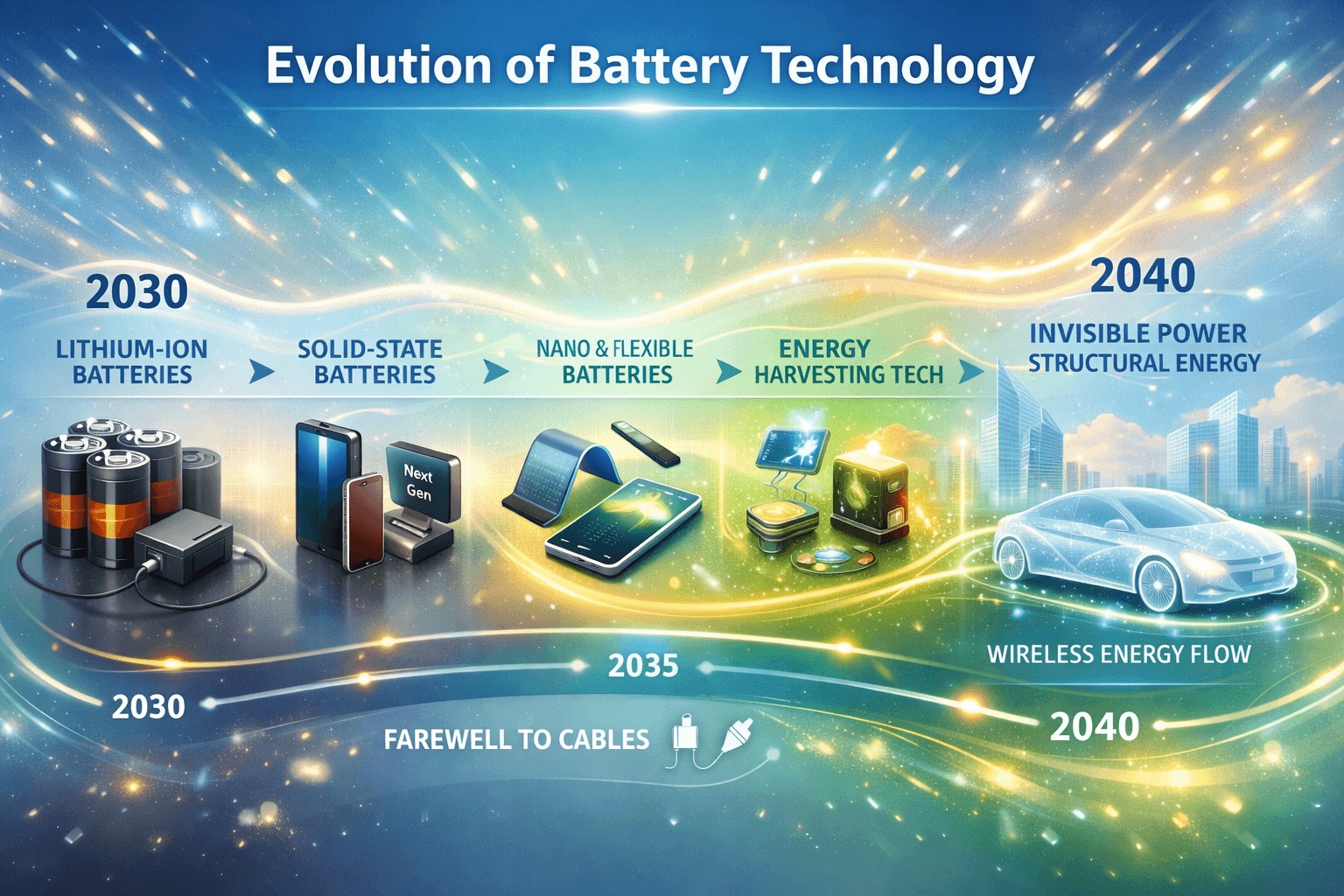
All of this is already funded, prototyped, and rolling into production: billions committed by Toyota, Volkswagen, Samsung, and a wave of hungry startups.
That desperate hunt for a power brick today will have your kids cracking up in fifteen years the way giant car phones make us grin now.
Ready for a world where your devices are always on—and never thirsty for power?