02. Holographic Revolution: The Day Screens Vanished Forever
Imagine: in just five to ten years, the word “screen” will sound as outdated as “cathode ray tube” does today. Ready for a world where your interface floats in thin air and the space around you becomes the display?
We’re racing toward the moment flat displays fade into history. By 2033, the last traditional smartphone screen will be headed for the scrapheap next to the BlackBerry keyboard. By 2035, 99% of personal interfaces will be projected holograms—from AR glasses, wearables, or even direct neural overlays. By 2040, more than half of all visual information will hover in mid-air, controlled by gestures, thoughts, or AI that reads your intent.
And this isn’t hype. These are breakthroughs happening right now in 2025: OLED pixels with metasurfaces generating true holograms, smartphones turning into 3D projectors, billions already poured in.

Three unstoppable waves already crashing in
-
Metasurfaces + OLED: real holograms from everyday pixels
2025: University of St Andrews demos a single OLED pixel using metasurfaces to create full holographic images—compact, affordable, no lasers required.
2028: Integrated into premium glasses and wearables, delivering glasses-free 3D.
2032: Mass-market holographic projectors in AR devices render real-time depth and parallax. -
AR glasses evolve into full holographic command centers
2025: Meta Orion prototype and Google’s AI glasses push the limits; the market floods with affordable options.
2029: Lightweight glasses fully replace phones, projecting holographic UI anywhere—no physical screen needed.
2038: Ultrasound haptics let you “touch” floating objects; AI crafts personalized holograms on the fly. -
Energy and compute breakthroughs enable always-on holograms
2025: Tensor holography and AI compression slash power demands.
2029: Photonic chips and edge AI handle real-time 3D rendering without killing the battery.
2038: Quantum-secured networks stream ultra-high-res holograms worldwide with zero lag.
What you’ll actually experience by 2030
- $500 AR glasses projecting full holographic workspaces, finishing off traditional smartphone sales.
- Holographic video calls: life-size 3D people standing in your room, captured by any device.
- AI that anticipates your needs and floats the info right in front of you—think “directions” and a hovering map guides the way.
- Pocket projectors turning any surface into an interactive 3D canvas.
- Glasses-free holographic entertainment: movies and games that fill the air around you.
A regular morning in 2040
You wake up. No phone, no tablet, no laptop in sight.
You think or gesture “agenda”—a holographic calendar materializes above your bed, spinning with a flick of your finger.
You say “call family”—life-size holograms of loved ones appear, walking around your room like they’re really there.
Your glasses surface notifications only when relevant. The mirror becomes a holographic news ticker. The coffee table transforms into a 3D game board.
Every interaction happens in light and open space—more natural and human than tapping glass ever felt.
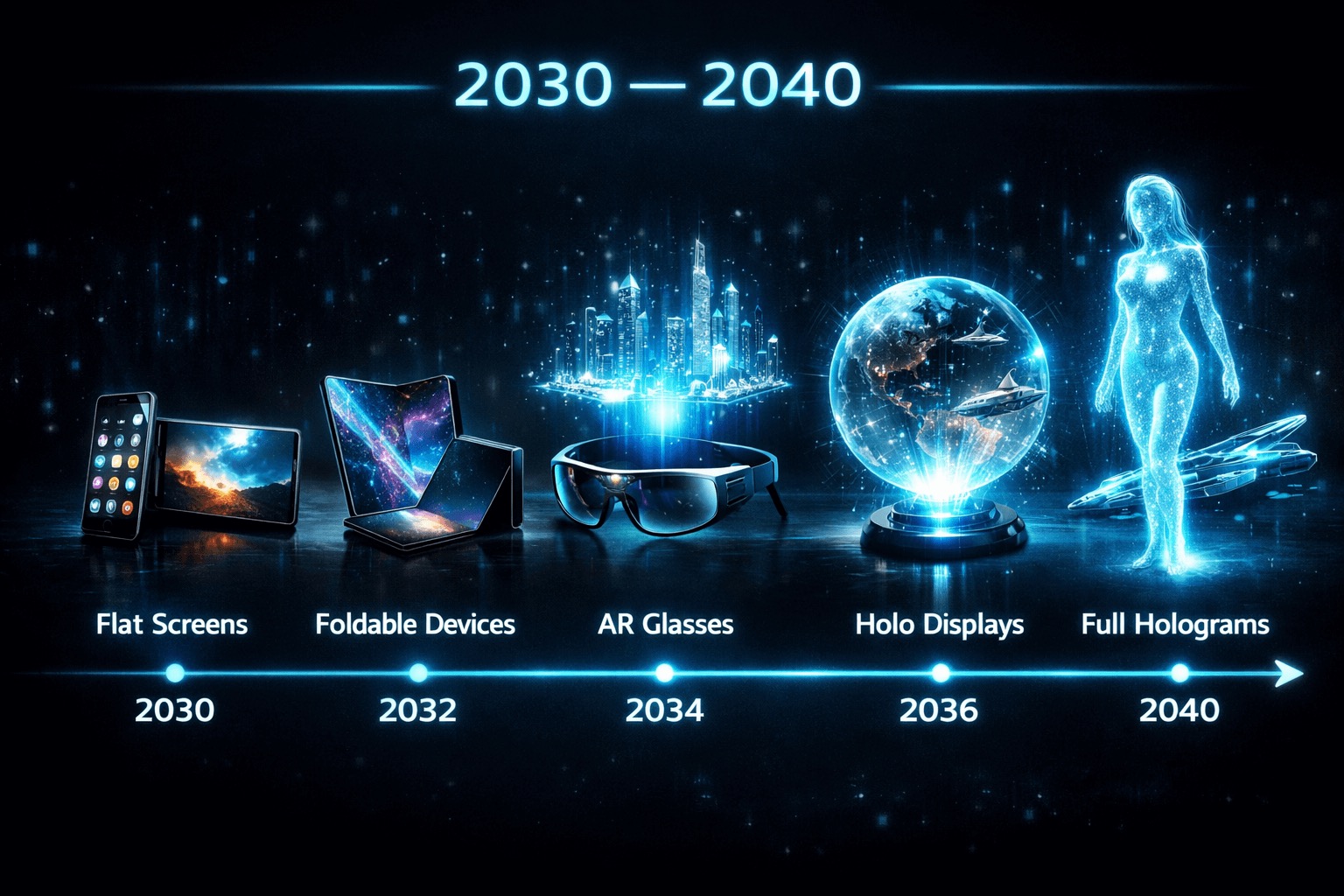
All of this is built on prototypes alive today in 2025: metasurface OLEDs, smartphone hologram projectors, massive investments from Meta, Google, Apple.
That slab of glass in your pocket right now will make your kids laugh in fifteen years the same way flip phones make us smile today.
Ready for a world where your interface is simply the space around you?